


Tickets
Improvised musics: Butcher/ Lash /Karlsen Trio plus Recurrence Plot
A double bill of sonic discoveries
Presented by: New Hinksey Recordings
| 0 | OXFORD: St Albans Hall (info) |
|---|---|
| P | Thursday 14th May, 2026 |
| N | Door time: 7:00pm Start time: 7:30pm |
| . | All ages |
| C | Music - General |
Event information
John Butcher - saxophone / Dominic Lash - double bass / Emil Karlsen - drums
"A master class in closely attentive group playing." (Julian Cowley, The Wire)
A trio made up of saxophone, double bass, and drums that sometimes sounds like it - and at other times sounds like nothing you've ever heard before.
John Butcher is a world-renowned virtuoso in taking the saxophone to places that other players can't even conceive of, let alone achieve. He has performed all over the world, from jazz clubs to contemporary music festivals to a 200m tall gasometer in Oberhausen. He recently worked with the Oscar-winning composer Daniel Blumberg on the score for Gianfranco Rosi's documentary Below the Clouds. Dominic Lash has worked with a diverse range of musicians from composers Tony Conrad and Éliane Radigue, drummers Chris Corsano and Tony Buck (from the Necks), and improvisers such as Evan Parker and Alexander Hawkins. Emil Karlsen (originally from Norway, now based in Leeds), is one of the most in-demand drummers on the UK creative music scene.
The trio's album, Here and How was released in 2023 and featured on BBC Radio 3. Foxy Digitalis declared that "restrained frenzy seems like an impossible thing, yet John Butcher, Dominic Lash, and Emil Karlsen found the tools to unlock it".
Recurrence plot
(electronic music for synthesiser and cello)
Martin Hackett and Bruno Guastalla’s ‘Recurrence Plot’ proceeds as a slow interplay of difference and repetition. Although duets may be perceived as dialogues or conversations, we tend to think of our work as accretions or co-constructions.
Martin Hackett plays a Korg MS10 synthesiser with an analogue sequencer. The
sequencer sends a fixed series of up to eight control voltages to the synthesiser, which are used to generate repeating pitch relationships. Any
attacks and durations delegated to the sequencer are unpredictable.
Bruno Guastalla’s recurring patterns arise in a different way: his cello is fed
through long multi-channel delays, sometimes modified in pitch or with the
addition of ring modulation. Repetition itself ought to be perceptible, but the
variety in frequency of repeat (a few seconds to a few minutes) may warp one’s
perception.
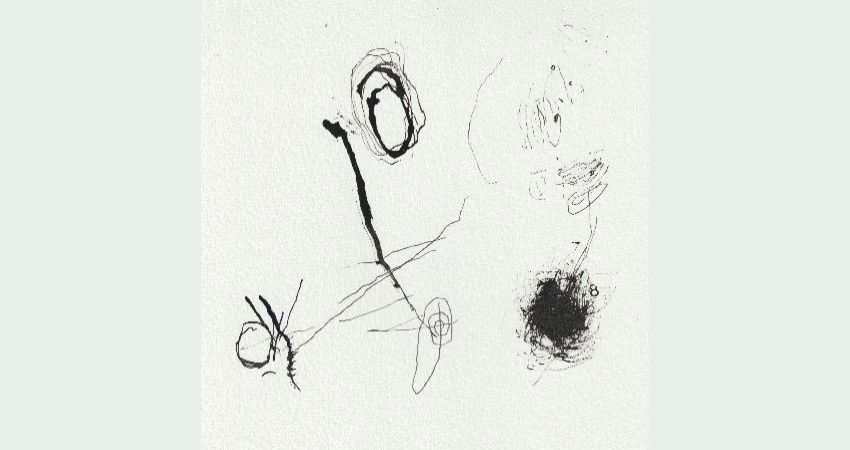
Drawing by Martin Hackett